
Quick Announcement: I’m helping organize this event for arts and cultural workers in Seattle. We’re going to talk about boards of directors, analyze power structures of arts orgs, learn research skills for organizing your workplace, and hang out with some of the sweetest arts workers in town. Would love to see you there!

I will admit, in last month’s roundup, in the sweet afterglow of a vacation to Philly, I was kind of a snarky cunt about Seattle. I stand by my saltiness and frustration, but the art I saw this month told me to knock it off: Seattle has some great art, and some great artists who love her. In particular, this month, I experienced one of the best dance performances I’ve ever seen, a delightful non-fiction reading series, a novel by a local author set just blocks from my house, and an electric drag show.
An artist/organizer friend recently repeated a maxim she’d heard: that you only really belong to a city when you organize in it, when you’re fighting (usually against the odds) to make it better. This reminds me of Hanif Abdurraqib’s exquisite There’s Always This Year: On Basketball and Ascension, where, in his acknowledgements, he thanks “the organizers in Columbus, who help bridge the gap between the city as its false self and the city as its true(r) self.” I think the same can be said of a city’s artists1: we are fighting to build and maintain culture and community despite the tech bros and real estate companies threatening to flatten it. Making art, organizing, and living in a city includes hating it like the bitch that I am, but also seeing what it could be, and fighting for that “true self.” I might not stay forever, but I’m here for at least another chapter, Seattle. I suppose I won’t give up on you yet.

The reservoir at Volunteer Park.
Terry Dactyl by Mattilda Bernstein Sycamore

I don’t think I’ve ever experienced a work of art set right where I live. Mattilda Bernstein Sycamore’s novel Terry Dactyl is set on Seattle’s Capitol Hill, my neighborhood. Our heroine (the titular Terry Dactyl) grows up on the hill, a few blocks east of me, by Volunteer Park. As an adult, she lives in a condo four blocks south of me; I walk by its cross streets daily.
Sycamore’s novel follows Terry as she grows up with Lesbian mothers in the 80s, their house full of dance parties and friends dying of AIDS. She then moves to New York, joining a group of club kids dancing, doing drugs, and trying to survive together. Simultaneously, Sabine, a gallerist who sees the potential in Terry’s vision, whisks her into the fine art world. When the pandemic hits, Terry returns home to Seattle, encountering her once radical, now very Lib mothers; the changes to the city she once called home; and the uprisings against police brutality that erupted in the neighborhood, including CHOP/CHAZ.
I particularly value how Sycamore writes place (she brings a similar care to Baltimore in her memoir Touching the Art). She dedicates pages to describing the trees in the park and her relationships to them (I imagine she and I have some mutual tree friends). She describes the hedges on my street with tenderness and gusto. She catalogs the graffiti and stencils on the lampposts (one of my favorite things about the neighborhood). Sycamore’s novel, like me, is frustrated with so much about this town: the ugly new buildings, the tech bros, the passive-aggressive fragility. But her attention to its details demonstrates a dedicated affection I’d like to adopt.
Non-Fiction for No Reason
In a basement in Pioneer Square, with an exposed brick wall, low lighting, and red wine in little plastic cups, lives ANTiPODE gallery. The gallery is “interested in cities because, unlike countries, cities are tangible. We can hate them, love them, live in them, leave them—and as immigrants, they can live together inside us.” This month, Antipode is the home of Non-Fiction for No Reason, a long-running (but recently on hiatus) reading series run by writer Katie Lee Ellison. I went for the first time at the end of March and heard several writers read their work—many of them writing about loving, hating, and grieving Seattle.
Amiri Amini, one of the owners of the gallery, read an essay connecting the “antipodes” of Seattle and Tehran. A highlight: he wrote about what it means in each city when people say it’s “nice” out: in Seattle, that means it’s sunny. In Tehran, that means it’s rainy, so the pollution gets washed away. In both cities, however, “it’s nice out” means that you can see the mountain. Amini read this essay as the US government bombed and threatened his other home, his other city. Then, J. Rycheal read about moving to Seattle from Macon, Georgia. They moved here knowing almost no one, and this place, different from what they had known, allowed them to turn into a new version of themselves. They’ve since returned to Georgia, inspired by a longing to connect more deeply with their ancestry. I was particularly delighted by their description of a pink tile bathroom in their one-bedroom apartment in Ballard (my dad’s house for many years had exactly this kind of bathroom). Finally, Seattle Civic Poet Dujie Tahat read a restaurant review from his forthcoming book of essays. He reviewed Belltown’s Lenox, a much-acclaimed Afro-Latin restaurant, reflecting on the kinship he felt on the plate, and the grief and nostalgia of watching a city you’ve loved change.
Less relevant to my Seattle theme, but equally enthralling, were readings from Aileen McGraw, Tamiko Nimura, Ellison herself, alongside a “non-fiction dance performance” from sullivan forderhase and Jai Kobi Kaleo’okalani.
TUSH
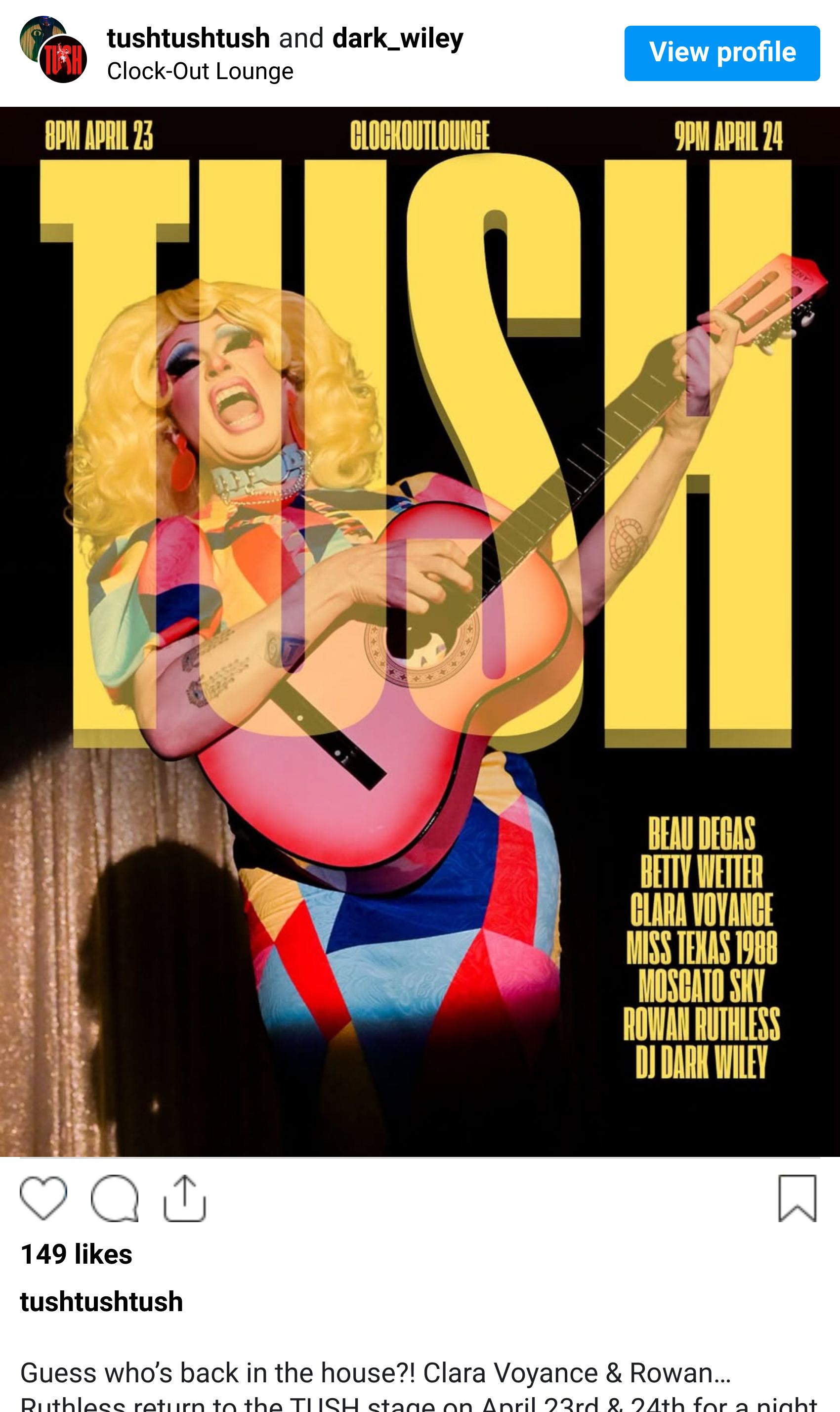
In Chicago in my twenties, every Monday night, all the artsy kids went to Salonothon at Beauty Bar. It was an open mic/reading series/variety show that presented some of the strangest, most exciting art in the city. But even more than that, it was a scene. Handshake deals for storefront theatre productions happened over cigarettes on the sidewalk outside. It was always supposed to start at 8, but never actually began till 9 (Monday is theatre weekend). It was a place to see and be seen. However, as my social anxiety (and art heartbreaks) got worse throughout my years in Chicago, I found myself more and more alienated from the space, too terrified of what others thought of me. Looking back, I miss it and wish I’d had more integrity to show up there as my full self. Maybe this is just nostalgia for my wild youth; or missing a cheaper, weirder city; or grieving all the cultural spaces that no longer exist post-pandemic. But I’ve longed for the energy of those Monday nights. In my aforementioned bitchiness, I sometimes pretend it’s impossible to find here.
It’s not. The scene, the cute audience, the electric art are at TUSH, a drag show at Beacon Hill’s Clock-Out Lounge. Last weekend, I walked into the Clock-Out after gorging on Dim Sum next door. The place was packed, full of people eating pizza and drinking cocktails. I recognized a dozen or two people in the crowd: my high school yoga teacher, friends from two (gay) faith communities, artists I saw perform a few days before, and an acquaintance whom one friend loves and another thinks is an asshole. People dressed for the occasion: leather shorts, some heels. It was a gorgeous night, so people smoked on the sidewalk outside (joints, not cigarettes; it’s Seattle).
The show, hosted by Betty Wetter, is so good at camp, at the bump-set-spike of theatrical suspense and surprise. Some highlights: an opening monologue from Wetter about her writer’s block in preparing for the show, scored to Whitney Houston’s “I Have Nothing”; from Miss Texas 1988, a magic schoolbus-inspired routine; and from Moscato Sky, a masterful use of a sheer piece of fabric to create silhouettes.
I also admire TUSH’s commitment to its community: Last year, they launched the Queer Sick Pay Fund, which gives queer nightlife performers PTO. The fund also just launched its first gender affirming care grant!
Again, There Is No Other by Amy O’Neal at On the Boards
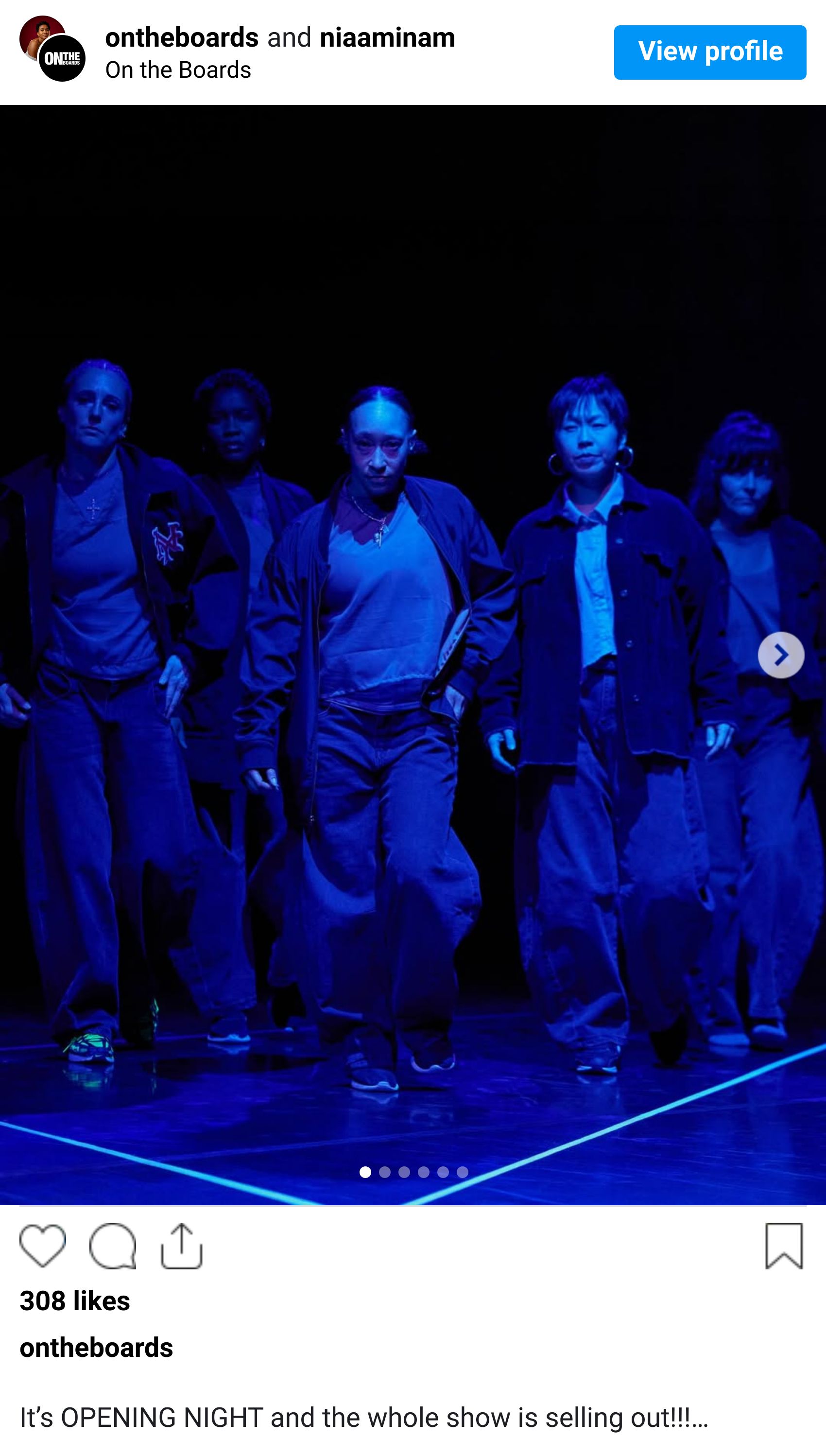
Amy O’Neal’s Again, There Is No Other (The Remix) is some of the best art I’ve seen in years. I mean this as an immense compliment: It made me boil with jealousy—at making a Great Work, at the depth of relationships that clearly birthed it, at the dancers’ pleasure in their bodies, at their embrace of femininity. I know enough, these days, to see jealousy as a compass; I already feel this work moving me towards desire.
Calling itself “a ritual of femme power and connection,” the piece began with five femme dancers in a phalanx entering in slow motion—an image they would return to repeatedly. They seemed to luxuriate in the movement of their hips, performing a powerful femininity I longed to try on.
Throughout, each dancer was completely unique in their movement, but also belonged so integrally to the whole. This was aided by incredibly smart costume design from Wazhma Samizay, who dressed the ensemble in black jeans, grey tops, and sneakers—but different versions for each dancer, reflecting their distinct energies. For a show about feminine power, this muted, nearly androgynous design might seem surprising. But instead, I felt myself marvelling at how they were inhabiting their genders, delighting in femininity as those gauzy t-shirts or oversized button-downs dripped off of them.
I not only loved the art, I loved the room it created. The show began and ended with a dance party, with performers and audience all onstage together. The crowd was multigenerational, diverse, engaged, wearing colorful jumpsuits, cheering at incredible physical feats, laughing at a cheeky moment of unison, fancy ballet steps. Again, I ran into people I knew: Several high school arts teachers, my sibling, a who ’s-who of Seattle arts people.
The piece also made me feel like we were all really in the same room. Performance is supposed to be a place of coming together, but I too often feel alienated: performers feel far away, above the audience, and my fellow audience members feel like strangers. This work vulnerably broke those barriers, creating a grounded, shared intimacy with 150 people. In a key moment about halfway through the piece, the dance stopped, and the lights came up on O’Neal and Tracey Wong sitting in one of the audience banks. Together, they sang a Portishead song accapella. They both have very nice voices, but it sounded a bit sweetly, earnestly off-key (as accapella singing often does). This made me feel like we were sitting around a campfire or doing carpool karaoke, enjoying the pleasure of singing together rather than the intensity and perfection of vocal performance. They then had a little chat full of gratitude and great closeness. O’Neal said something like, “Thank you so much for sharing that with me.” They laughed and then sang an R&B song (I wish I could remember which one!) while the audience clapped and sang along. We were all there, in the room, together.
After this interlude, the second “act” maintained the same overall dramaturgy as the first, but changed tone. While the first half was marked by a steely, sultry intensity, the second half was bursting with wild, free, infectious joy. Last month, I wrote about Renee Gladman’s idea of “sublimation,” when a performer “goes under, crosses into freer territory, where the rules of what is and isn’t, of what’s inside and outside are malleable.” That was all I could think of during a house-inspired trio, where all three dancers are consistently touching each other’s shoulders, interlacing themselves together while performing fast, thrilling steps. They all had bliss on their faces.
I saw the show on closing night, so I got to witness the bows, the tears, the flowers. Ferociously embraced by her collaborators, O’Neal—who came up in Seattle, before living in LA, but then recently returning—said: “It’s good to be home, and it’s good to be held.” Just two weeks later, O’Neal won a much-deserved Guggenheim fellowship.
Occasionally, a work of performance rips open possibility, makes something previously unheard of. In my lifetime, I think of Lucas Hnath’s Dana H, the Belarus Free Theatre’s Being Harold Pinter, Alexander Ekman’s Midsummer Nights’ Dream, Young Jean Lee’s Untitled Feminist Show. O’Neal’s piece is (excuse the pun) like no other. I felt such pride that this art was born in my hometown.
Reminder that once a month-ish, this newsletter publishes I Will Always Love You, an advice column for creative collaborations (inspired by Dolly Parton herself). I’m looking for questions about your love affair with your lighting designer, your jealousy of your conservatory classmate, your long-distance literary penpal angst, and much more. You can read more about the inspirations for this column here, and you can submit a question here.
1 Though I don’t think this removes the artists’ duty to do the plodding work of political organizing, a duty we can often shirk in the quest for individual acclaim.
