
Reminder that monthly-ish, this newsletter publishes I Will Always Love You, an advice column for creative collaborations (inspired by Dolly Parton herself). You can read more about the inspirations for this column here.
I’m currently out of letters to answer, so write to me about your studio-mate sculptor (who you wish was your bed mate), the drummer in your band who always talks over you, the cool kid poet who you wish would talk to you at readings, and much more. Send me your juiciest quandaries!
Another month and some more exquisite art. We’re heading towards the season when it’s hard to be inside, when Seattle gets so gorgeous and the evenings last so long that entering a theatre feels like mummification. I see less art because I’m on the diving board or cooking in my backyard. Come fall, the only solace for my end-of-summer grief is the extinction of my kitchen fruit flies and walking back into a theatre and sitting in the dark. This summer, perhaps, I’ll turn more to novels (in the yard, on the beach, in streetside cafés) and galleries (where natural light pours in). But for May, I’ll share an interview podcast, a performance/lecture, and a film. See you in the sunshine soon, my friends! (Also, I’ll be on vacation next week, so you’ll get the next newsletter two weeks from now!).
If you are looking for some creative rocket fuel, for one of the best interviews I’ve heard in years, with one of the great artists of a generation, look no further than this talk with poet, actor, and filmmaker Saul Williams. This talk is on the excellent podcast Between the Covers, hosted by David Naimon, who I think is hands-down the best interviewer in the arts. Some other choice episodes include interviews with Omar El Akkad, Mattilda Bernstein Sycamore, Molly Crabapple, and Isabella Hammad.
Over the last decade, Williams has been working on a suite of Afrofuturist artworks about technology and extraction, set in a magic-realist, anti-imperialist, hacker world. These works include the 2016 concept album MartyrLoserKing, the film Neptune Frost, the Bill T. Jones-curated-and-directed dance performance Motherboard Suite, and now a graphic novel with art from Morgan Sorne, also entitled Martyr Loser King. I’ve experienced all of these except the graphic novel, and I think they’re some of the most exciting artworks of our time.
The word “mine” is a central exploration in the interview. Mining—the theft of Mother Earth’s very soil, extracted from colonized lands, enacted through violent enslavement—is the setting and core interrogation of these works. But, being a poet, Williams also unearths the other meanings of the word: ownership and private property, delving deep (as in “mining creatively” or “mining memory”), and greed. This struck me after my recent essay on Kristen Stewart’s film The Chronology of Water, wherein I argue that the word MINE—used at a crucial moment in the film, and tattooed on Stewart’s thigh—is the thesis of the film. There are multiple explorations here: the white feminist impulse towards ownership and hoarding, towards theft of resources and ideas under the auspices of empowerment. But MINE, as a thesis, can also guide one towards claiming what belongs to you (body, dignity, artistic vision) and surrendering what doesn’t. Williams speaks about a “moment of maturity” he reached in his career when, faced with the pressure of industry and ambition, he decided that
I really only want what's mine. I don't need everything. I just want what intuitively feels like it's connected to me and that this is a place where I can be of service and perhaps be fueled or serviced by interacting with it. I really only want what's mine. I don't want everything.
It reminds me of a vision from a friend, the musician and video artist Wynne Greenwood: “I want to make the art and music that’s mine to make.” How freeing, to seek what is ours; no more, no less.
My elevator pitch for this newsletter is that it’s about “art, politics, and the divine”; it is the interplay of these three forces that made this interview catnip for me. Williams discusses his ambivalent relationship to religion and his powerful relationship to spirituality. “Do we belong to religions or do they belong to us?” he asks. Using a linguistic play only available to a poet, he shares the mantra “thou art God”: art is what connects “thou” and “God.” He also talks about the spiritual ecstasy of artistic coincidence, when something happens so accidentally and so perfectly that it feels only possible through divine intervention: the perfect song literally knocking on the door in a moment of writers’ block, or meeting his wife and creative partner because a director wanted them to do a “chemistry test” for a film. “We literally have been together every day since that day,” he said. It’s such a cute story (a chemistry test!), but also a reminder that art guides us towards Love, towards the divine. “Really it’s about openness, right?“ he says. “I trust in the universe.”
Mindy Seu’s A Sexual History of the Internet
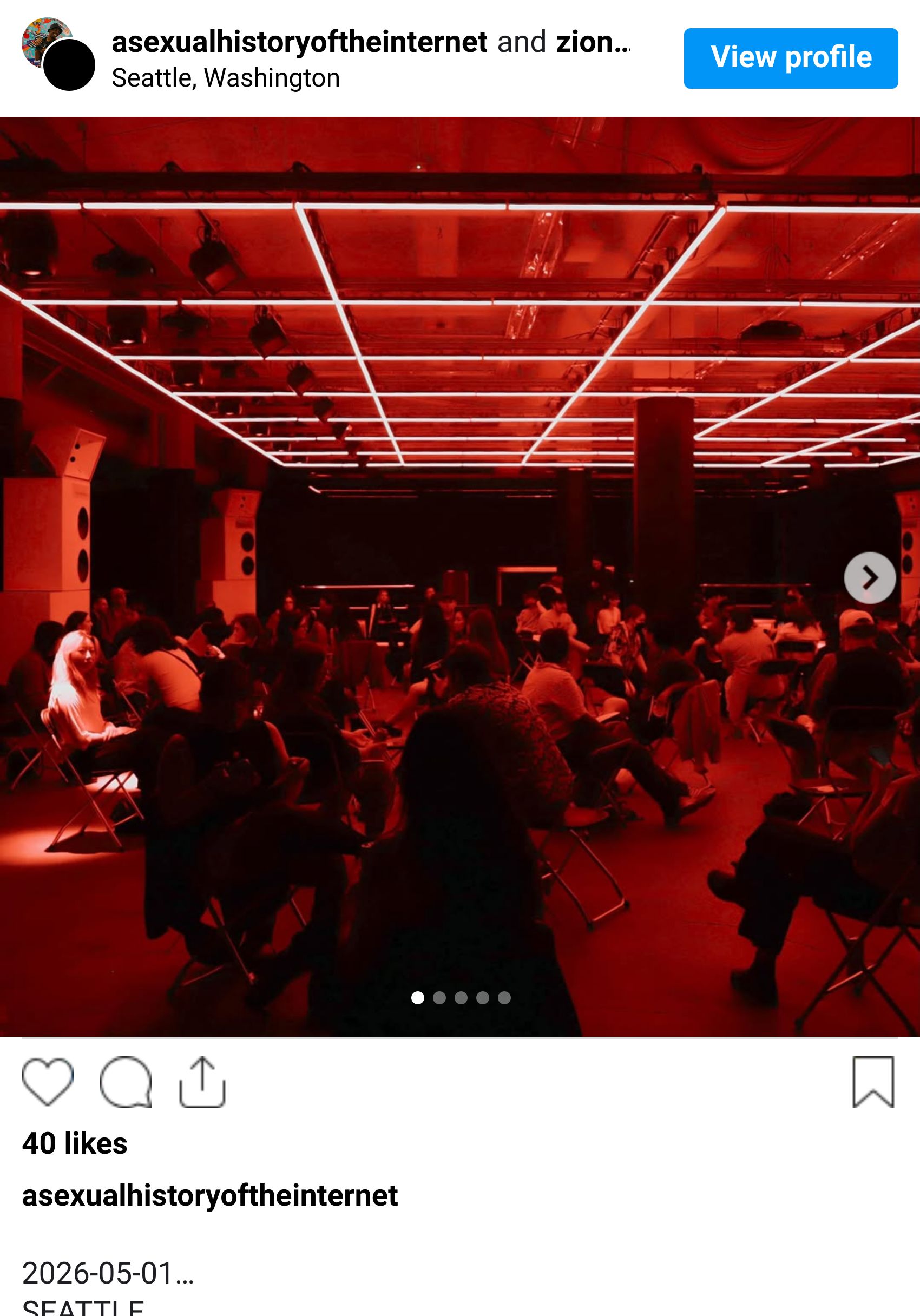
In the basement of Seattle’s Cannonball Arts was a room draped in red light, with dozens of folding chairs scattered across the floor, facing every which direction. Months prior, the second they went on sale in Seattle, I bought tickets to Mindy Seu’s A Sexual History of the Internet. I’d read some reviews of it in New York, and it sounded wild.
A Sexual History of the Internet is a lecture-performance from artist Mindy Seu, who is part of the very cool Dark Forest Collective, a group of artists and researchers exploring alternative and liberatory approaches to the internet. The piece is constructed through a slideshow of Instagram stories, which each audience member watches on their phone, alongside about 100 people around them. Seu reads parts of the lecture out loud, but also, through a color-coding scheme, audience members read certain slides aloud, like a slightly cacophonous collective play reading. If you wanted to, you could experience the whole thing on your own, right now, for free, on Instagram—though the experience would be considerably different than doing it collectively. The lecture is also available as an art book, a tome exactly the footprint of an iPhone but several inches thick. The book is a “financial experiment”, wherein everyone cited in it receives a portion of the profits.
A Sexual History of the Internet is interesting to consider up against Williams’ art: while Neptune Frost (and its associated works) are about technology’s exploitation of Africa’s land and people, A Sexual History… explores the internet’s exploitation of sex workers. “From personal websites to online communities, cryptocurrencies to AI, the internet has been built on the back of unattributed sex workers.” Both of these realities are left out of mainstream “techno-history.”
I looked up at one point in the performance and saw 100 people staring intently at their phones with various colors of light shining sharply on their faces. It’s not uncommon to see dozens of people staring at their phones at the same time (on a train platform, at an airport, in a waiting room, etc). But staring at your phone is usually profoundly isolating, so it was fascinating to engage in the gesture of a doomscroll but experience it collectively.
Jaripeo Directed by Efraín Mojica and Rebecca Zweig
At the Seattle International Film Festival, I got to see JARIPEO, an experimental documentary about gay rodeo culture in rural Mexico. The film was co-directed by Efraín Mojica, who grew up in Michoacan, immersed in Jaripeo culture. The film alternates between bright, loud, riotous rodeo scenes (cowboys barely escaping concussions, tequila poured directly into mouths); heartfelt and intimate conversations; and psychedelic, dreamlike sequences. Some highlights: a dark, colorfully lit dream sequence featuring a mechanical bull, which smash-cuts to a hyper-realistic mechanical bull bucking violently in the middle of an arena in broad daylight (smoke blowing from its nostrils in both shots). Also, a surrealist representation of cruising in a cornfield, evoked with red strobe lights.
I got to hear a talkback afterwards with Mojica and co-director Rebecca Zweig. Every time I hear documentarians talk about their work, they describe the hours spent with their subjects without cameras rolling. What appears on screen is so intimate that I marvel at the deep hanging out that must have allowed it to happen. (shhhhh….it all makes me wanna make a documentary!)
