- I Have a Ribcage; You Have a Ribcage
- Posts
- Reactionary Bullshit in the Arts: A Roundup
Reactionary Bullshit in the Arts: A Roundup
And a rant
JESSE ROTH
April 03, 2026
Reminder that once a month, this newsletter publishes I Will Always Love You, an advice column for creative collaborations (inspired by Dolly Parton herself). I’m looking for questions about your love affair with your lighting designer, your jealousy of your conservatory classmate, your long-distance literary penpal angst, and much more. You can read more about the inspirations for this column here, and you can submit a question here.
One of my “beats” is the ways arts organizations maintain empire and domination—and the people who organize to fight back. My intention for today was to write about five different political clashes in the arts over the last few months. But then I got so angry that I only got to half of what I wanted to discuss. So you may get a part II sometime soon, discussing some queer erasure at the Seattle Art Museum; the organizing against Israel, Russia, and the US’s inclusion in the Venice Biennale; and the Art Gallery of Ontario reneging on a Nan Goldin acquisition because of her Palestine activism. But for today, here’s a debrief on some chaos at the Berlin Film Festival, and what the Epstein files can tell us about how billionaires use art to hoard wealth.
The Berlin Film Festival
Source: Wikimedia Commons
This saga is quite a clusterfuck, wherein people are being quite zionist and reactionary, but still getting attacked from the right wing for supposedly being antisemites. Baffling!
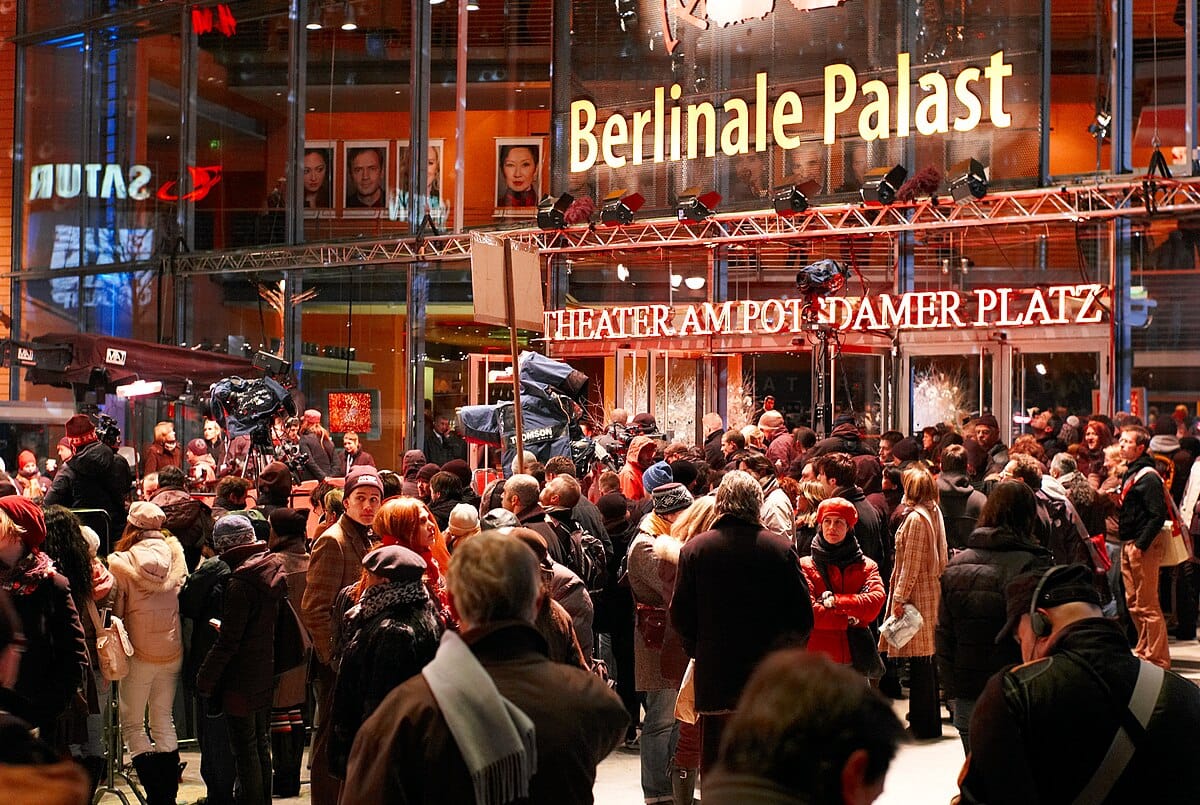
The Berlinale, or the Berlin International Film Festival, is part of the circuit of European festivals (Cannes, Venice, etc); prestigious but not the crème de la crème. In the past several years, the film festival has taken reactionary positions on Palestine—banning clothing “incompatible with the liberal democratic order” (read: Keffiyehs). But this year it escalated even further.
This year, the festival began in mid-February with an institutional chilling of political speech. At the festival’s opening, a journalist asked Wim Wenders, the festival’s president, about the German government (the funders of the festival) and their support for Israel. Wenders replied, “We have to stay out of politics, because if we made movies that are dedicatedly political, we enter the field of politics. But we are the counterweight to politics. We are the opposite of politics.” Notably, two years ago, at the same festival, he said, “The Berlinale has always been the most political of the big festivals.” As is often the case, when Palestine comes up, it’s time to get apolitical.
This sparked a wave of protest against the festival. The ever-principled Arundhati Roy dropped out of the festival. A group of 100 film professionals (including Mark Ruffalo, Javier Bardem, and Tilda Swinton, who was one of the festival’s honorees) signed an open letter disagreeing with Wenders’ separation of art from politics. They wrote that the Berlinale is exhibiting what Irene Khan, UN Special Rapporteur on Freedom of Expression and Opinion, called Germany’s efforts “to restrict advocacy for Palestinian rights, chilling public participation and shrinking discourse in academia and the arts”. They also quoted filmmaker Ai Weiwei, who said that Germany is “doing what they did in the 1930s” against a different target.
The festival director, Tricia Tuttle, replied to the letter in an interview in Screen Daily. Her comments are rife with passive voice sentences about the violence that’s “continuing to be enacted” against the people of Gaza (by whom Tricia?? Who is enacting this violence??). When asked why the festival had not spoken out about the genocide, she said that the festival is representing people who “want a more generous understanding of Israel’s positionality.” She says the festival needs to “hold space” for “complexity.” (She talks about “holding” or “providing” space four times).
Filmmaker Abdallah Al-Khatib (source: Wikipedia)
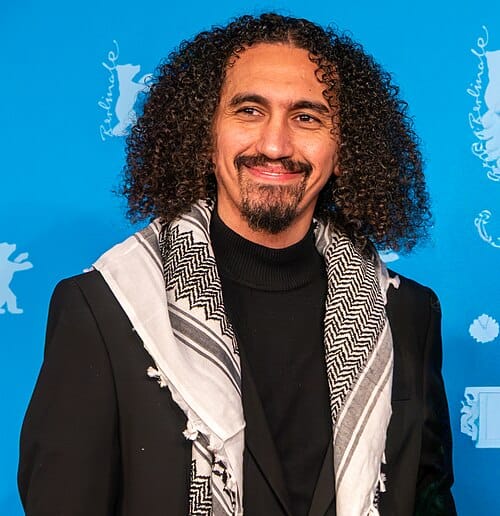
Then, during the festival, Palestinian-Syrian film director Abdallah Al-Khatib’s film Chronicles From the Siege won Best First Feature. In his acceptance speech, he said that the German government is “partners in the genocide in Gaza by Israel.” He finished his speech by saying, “We will remember everyone who stood with us, and we will remember everyone who stood against us, against our right to live with dignity, or those who chose to be silent. Free Palestine from now until the end of the world.” He then unfurled a Palestinian flag.
In response to Al-Khatib’s speech, the German environmental minister walked out. The German government then went after Tuttle for not sufficiently shutting down the protests. They accused her—who gave the most milquetoast statement ever, who “created a safe space” for genocide denialism—of being an antisemite and threatened to fire her.
At this point, a considerably larger group of filmmakers signed another open letter defending Tuttle. This letter calls for freedom of expression and for the importance of “space [that word again! They use it five times!] for filmmakers, artists, professionals and audiences to come together.” It uses a sort of pseudo-leftist word salad: “lived experience,” “with care,” “nuance,” “…where discomfort is embraced,” “expansive,” “grace, respect, and solidarity.” This letter never once mentions Al-Khatib or offers him solidarity. It never mentions Palestine.
Tragically, this demonstrates a much larger coalition defending the career of this particular arts leader than the coalition of filmmakers defending millions of Palestinians. But this is a classic case of “first they came for…” The German government came after this woman for insufficiently shutting down political speech. The letter states that we “risk losing spaces like these completely.” The only way to defend your speech is to fight for the speech of the most marginalized. No matter how much you call for “genuine freedom of expression”, if you don’t stand up for the man unfurling the Palestinian flag onstage, the reactionary government will come for you too.
It must be exhausting to write these statements that sound like a shitty, reactionary-centrist version of a social justice somatics curriculum. Just say “Free Palestine” instead.
Learn more:
The ever-excellent Fariha Róisín’s essay “Art is Political That's Why So Much of it is Bad”
The second half of Matt Bernstein’s episode “The Epidemic of Celebrity Cowardice.”
The Arts, as Revealed in the Epstein Files
The Epstein files have offered a look into the previously opaque communications of the ultra-rich, offering information across fields—including, crucially, the arts.
In particular, Epstein offered financial advice to many billionaires, among them Leon Black and Ronald Lauder. Both of these men are some of the largest art collectors in the world, and they are on the board of the Museum of Modern Art. In 2021, it came out that Black had paid Epstein $158 million for financial advice. He was also accused of raping a sixteen-year-old girl with Autism at Epstein’s New York townhome. Both Lauder and Black are complicit in a number of global atrocities, in particular Israel’s occupation and genocide: Black is a major donor to Birthright, and Lauder is the president of the World Jewish Congress and a significant Trump donor.
Prior to these files, I would have thought that art was a marginal strategy for these billionaires to maintain and expand their wealth. However, Katya Kazakina, a reporter whose beat is art markets, describes how art can be a huge part of their wealth hoarding—and how these files show how Epstein led the charge on this strategy. For example, in 2015, Black’s net worth was $4.8 Billion, $2.7 Billion of which was art: 56%. Why put so much of your wealth in art? Because tax codes around art are particularly excellent for tax evasion.

My $23 Million Picasso. Portrait de femme (Dora Maar). Pablo Picasso (1881-1973). oil on panel. Painted in Paris, 5 August 1942
To illustrate, let’s pretend that I own a moderately priced $23 million Picasso. Now, let’s say that, for some reason, I think that the Picasso might start to dwindle in value (or…like a flighty Billionaire, I’ve just taken on a fourth wife, and Picasso isn’t to her tastes). I want to sell, and I want to sell high, right? But if I sold that Picasso, I would owe millions in capital gains taxes, which would be devastating. So, instead, I can make use of a “1031 exchange,” and swap the Picasso for a Monet (my new wife loves water lilies). Theoretically, I can “swap till I drop,” continuing to do this forever while these works accrue value, never ever having to pay capital gains taxes.
But let’s say that I want to…buy an apocalypse bunker compound in Hawaii, or…the art market is cooling a bit, but the stock market is hot; I need to be more liquid. But if I sell it, I have to pay those damn capital gains taxes! Not to worry: I can use the art as collateral for a very, very low-interest loan. I get to keep the paintings in my Park Avenue apartment, and the bank will give me a 1-2% interest loan (basically free money).

An equally priced Monet. Matinée sur la Seine. Claude Monet. oil on canvas. Painted 1897.
Now let’s say I want to buy a painting, but it’s a bit of a risky bet, and I don’t want to shoulder that risk alone. Well, as Black and Lauer did, I can go splitsies on a painting with another billionaire. The two created a holding company called “Friends LLC” to buy a Kurt Schwitters work, and then negotiated that they would pass it back and forth every 2.5 years. This was a pioneering art collecting practice, which Epstein helped develop: eventually, it became possible to buy fractional shares of a painting. You could own 7.9 percent of a Kandinsky, like you’re buying Google stocks.

The painting that Lauder and Black went in on together. “Ja - Was? - Bild” by Kurt Schwitters. Oil, paper, corrugated card, cardboard, fabric, wood and nails on board; in the artist's frame. 1920.
Museums also play a huge role in maintaining and expanding wealth “stored” in art objects. I’ve done a lot of thinking about artwashing and reputational laundering through arts organizations, but I hadn’t thought as much about arts orgs’ material role in wealth accumulation. I organized an event recently where a comrade, a worker at Seattle Art Museum, spoke about the ways the museum’s board profits off his labor. One of the major ways art maintains and grows in value is by being displayed. So, it is to the advantage of these billionaires for their art to be shown. Hence, these art-collecting billionaires often join the boards of art museums because then they can influence what is displayed. Further, they can loan their works to the museum, where the work gains value through public display, and the museum (and its underpaid, exploited employees) takes on the labor of caring for the work. For their “generosity,” the billionaire gets a free security department to protect the asset, a restoration department to maintain it, a curatorial team to explain its value, and a marketing team to publicize it. They even get an education and community engagement department to propagandize its worth to future generations!
This all breaks my heart, because I love art, and it is so spiritually bankrupt to treat it like part of a portfolio. The spreadsheets in the Epstein files make clear a previously opaque world, showing the craven way the uber wealthy use art as a poker chip.
A Curse and a Blessing
In response to this, I offer a curse and a blessing. To those silently endorsing and profiting off mass death, to those treating holy objects as “assets,” to those accelerating systems of rape and violence: may you never know the peace or pleasure of art well-made, may your pencils break and your lenses shatter, may your writing be blocked, may you never know the frisson of joy at a resplendent work; I curse your artistic process and consumption with shame and hollowness.
To those who stand up bravely, may you experience the divine joy of art-making, may you have abundant flow states, may the art fill your soul, may your works exceed the sum of their parts, may they find audiences who love them wholeheartedly, may you find resources to support you, beyond all odds. I bless your art as divine.
Reply