

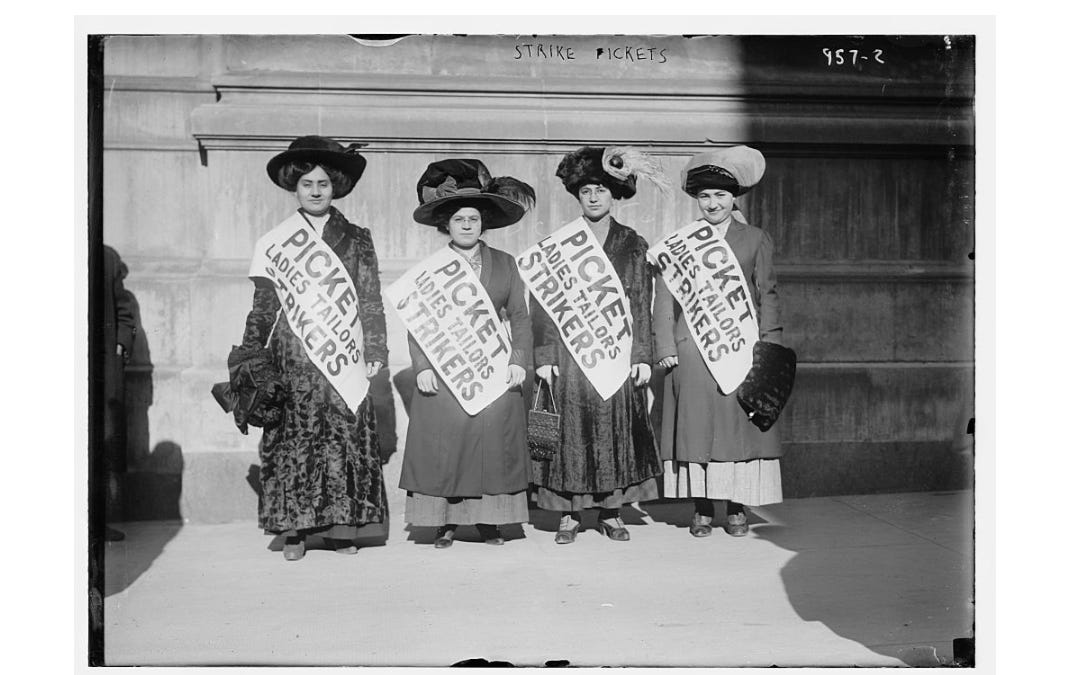
Striking garment workers during New York’s “Uprising of the 20,000”, 1910. Source: Library of Congress.
On Tuesday, the Feminist Food Journal published “The Jews who Ate Pork ‘Till the Pigs were Called,” an article I’ve been working on for over a year. I wrote this piece with two goals: to feel more anarchist and to feel more Jewish. What a delight to succeed at both.
The piece is about turn-of-the-twentieth-century Yiddish anarchists and Yom Kippur balls, raucous, sacrilegious parties they threw on the holiest day of the year. These parties became a flashpoint for controversy and violence between anarchist and religious Jews, and in several cases, the religious Jews called the cops. These parties are a parable for our present moment, when many conservative Jewish institutions are allying themselves with state violence (both in the US and as part of the zionist regime), while leftist Jews are fighting against it.
Shortly after the israeli state escalated its genocide after October 7th, when I was fairly new to anti-zionist Jewish organizing, I found myself deep in a rabbit hole about ancestor allies. I read a Jewish Currents conversation between scholars Claire Erlich, Anna Elena Torres, and Kenyon Zimmer entitled “The Lost World of Yiddish Anarchists: It’s more than just Yom Kippur Balls.” This article presented Yiddish anarchism as a deep commitment to culture and beauty—plays, literature, language, food. In their paradigm, culture and politics were inextricably linked. I was also particularly moved by this passage from Torres:
Yiddish anarchism was invented by refugees who theorized from their experience of border crossing—how does that history relate to anticolonial anarchisms and indigenous critiques of the state? I think both share a consciousness of deep time and life before the rise of a nation-state; this remembering has the potential to destabilize the present moment, reminding us that there’s nothing truly inevitable about militarism and nationalism.
I developed an affection and admiration for these Yiddish anarchists, their orientation to time, their rejection of borders and states, and their resolute commitment to art and culture. During this time, I was also developing my anarchist politics. Though I’d done a bit of reading and flirted with its ideas previously, from 2023-2025, I dove deep into anarchist thought. As the protests against the genocide in Gaza accelerated, late at night after actions, I blitzed through David Graeber’s 400-page Direct Action: An Ethnography. I facilitated consensus decision-making processes in organizing meetings, and realized that even though it can be a total pain in the ass, I found it quite fun. The mutual aid work I’d been doing for several years took on new meaning. I still felt like a bit of an imposter, but I became increasingly compelled, spiritually, by the tenets of anarchism: a world organized by cooperation and mutual aid; taking action to build the world we want, now, with our own two hands; an end to borders, police, prisons, and nation-states. I wanted to go deeper.
Simultaneously, I was also dipping my toes further into Jewishness. Though I had rabbis amongst my ancestors, I also had four atheist Jewish great-grandparents. By the time my dad was a kid, my grandfather had no Jewish spiritual or cultural practice—likely due to a combination of atheism, assimilation, and being orphaned at a young age. My blood ancestors weren’t radicals, they were capitalists, shilling tobacco and razorblades—evidenced in the silver tray on my coffee table and the truly absurd quantity of monogrammed linen napkins passed down across generations. I was raised by my new-atheist-movement, Richard-Dawkins-following, godless dad. I would joke that I was “the wrong quarter” Jewish (on my father’s father’s side), until some very thoughtful people told me that understanding was quite patriarchal. Until recently, I didn’t identify as Jewish.
However, as the genocide raged on and thousands of Jews showed up in the streets, it felt like an increasingly important identity to claim. I also found myself, suddenly, amongst a new swath of friends and comrades lighting candles and singing songs on Friday nights, practicing Judaism in a queer, witchy, radical, non-prescriptive fashion. I was deeply moved; I felt immense belonging. Again, I still felt a bit like an imposter, but less and less as I was invited deeper into organizing, culture, ritual, and community.
Throughout this experience, I’ve thought about Anna Elena Torres’ phrase “deep time” consistently, sometimes while sitting beneath my favorite tree. Sometimes I’ll sit in her little nook just large enough for my body, and do Generative Somatics’ centering practice, which asks me to notice the back of my body and imagine time stretching backwards, noticing the ancestors who have my back. I feel that tree behind me, and I remember that she has been around since before this nation state’s violent beginning. I also feel these Yiddish anarchists, and they remind me that in deep time, zionism is but a blip. God willing, may these colonial nation-states crumble before I die and the tree falls.
Last year, I was working on a pitch for the Feminist Food Journal. I’ve been a longtime fan of this magazine: I’m consistently impressed with their connecting the personal and political, with their attention to detail, with their gorgeous hand-drawn illustrations, and with their international scope. Each issue features a theme: MEAT, SEA, or SEX, for example. Some favorites include Apoorva Sripathi's essay on milk and Hindu nationalism, Julia Norza’s essay on the “soy boy” panic and trans-ness, and María Villalpando’s reporting on the Patsari Stove, a new tool used by women in rural Mexico to make tortillas.
FFJ was seeking pitches for their CELEBRATE issue, wherein they asked for pieces that “look at celebration — conviviality, commensality, the elevation of the everyday, and the reverence of the sacred — as a radical act: an act of self-care, of community-building, of political resistance.” In particular, they were interested in investigating the politics of celebration during this terrifying and agonizing political moment. I returned to the reading I’d done on Yiddish anarchists and did more research about these balls: joyous celebrations, vicious rebukes of the tie between state and synagogue, and sites of controversy and violence within Jewish communities. It seemed like the perfect story for the issue—a hidden history relevant for our times—and I was delighted when Isabella and Zoë (FFJ’s editors) decided to commission it.
I loved spending time in history books with these rabidly atheist Jews, people who held a deep devotion to Jewish culture but loathed and partied and rioted against it as an organized religion. I feel like they would hear me say “not Jewish enough” and scoff, hand me a cigarette and a ham sandwich, and tell me to get my ass into the party (though suspicious of my altar and the seders I attend). Two of the most intense periods of working on the essay—finishing the first draft and polishing off the final piece—took place over Passover, which felt both holy and cheeky. These ancestors were dogged journalists and historians, obsessed with writing things down, so this essay honors them, in their tradition.
In writing this, I also loved being a food writer. Though my “beat” is mostly art and God (the latter to the consternation of many who came before me), food is in the wings. I am a hostess—whether on the page, in a theatre, or at my table. I’m grateful to the glut of whip-smart food writers I get to read and connect with on the internet (both Feminist Food Journal and Alicia Kennedy’s Tomato TOMATO community are loving homes for us). I loved scouring every source I read for the menus; I squealed when I learned about the pickles and ice cream puffs. I feel such integrity in talking about food as cultural organizing, why I so relentlessly believe in food, art, parties, and dancing for our collective survival. One anecdote, which was initially part of the essay’s conclusion, expresses this so well I had to share it here: In a talk at the 2024 Socialism Conference, Palestinian American writer and organizer Eman Abdelhadi said that at a certain point in the preceding year of organizing against the overwhelming genocide, her partner had said, “I think my role is more like… feeding you, than going to meetings.” In response, Abdehedi said that she thought, “You’re a good feminist. That is really an important role. I need to go to the meetings. And I need to be fed.” These are my politics.
One of the most challenging parts of this essay was wrestling with these anarchists’ relationship to zionism. While some were anti-zionist from beginning to end, others were, frustratingly, less resolute. In an early draft, I focused more exclusively on these Yiddish anarchists’ anti-zionism. But over several months, it kept me up at night that I was looking away from their errors. In particular, I found myself frustrated and angry at Emma Goldman—in many ways the heroine of the piece—who, despite saying she opposed zionism, spouted some quite zionist propaganda.
While working through this, I thought about Marina Magloire’s powerful archival work on the friendship between Audre Lorde and June Jordan, and their falling out over Lorde’s support for zionism throughout much of her life. I also thought about Sophie Lewis’ excellent book Enemy Feminisms, and her practice of calling out the evils of many feminist ancestors. Magliore and Lewis take different approaches: Magliore said in a podcast that she’s not trying to “cancel” Audre Lorde, instead, she wants the reader to ‘look at [Lorde’s] journey with a bit of humility.” Lewis, instead, focuses on figures from feminist history (fascists, Klanswomen, white supremacists, cops) who should be named as enemies, but are too often whitewashed as feminist heroes. I think both of these practices are crucial. Lewis’ truth-telling scalpel inspired me to share Emma’s reactionary and violent words clearly, but I largely chose Magliore’s approach in reckoning with Emma: claiming her as an ancestor and a revolutionary, but a flawed one.
In the zine Dwell in Revolution: Ancestors for a Judaism Beyond Zionism, Maura Finkelstein writes a fictional letter from Emma to us in the present, claiming her wrongs. “Do not look for heroes in history, we will only disappoint you,” Finkelstein-as-Goldman writes. “Instead, use us as tools for your own revolution.” Emma’s failings prompted me to seriously reckon in the essay with the contemporary Jewish left’s failings. By spending time with her, I can find humility, seeing the places where I, too, turn away from my principles.
About a week before publishing this, I was speaking to my somatic therapist while freaking out a bit. “You’re growing your capacity,” they said. I agreed: even if my worst nightmare happened and everyone—friends, comrades, collaborators, internet strangers, IRL strangers, enemies—hated it, my capacity would still grow. On the other side of publishing it, I marvel at the way artmaking creates integrity—like a glacier scraping against rock. If I let it carve me, I can become sharp and solid in what I’m here to do on this planet. It’s an honor to share this work with you; I hope you read and value the piece.
A great number of contemporary anarcha-feminists, leftist Jews, talented artists, wise healers, and dear friends offered eyes, feedback, expertise, and counsel during this writing process. I am beyond grateful for them. Here are the names of several of them: Stacey Prince, Raechel Anne Jolie, Kate Raphael, María Matienzo, Martha Hurwitz.
Reminder that once a month, this newsletter publishes I Will Always Love You, an advice column for creative collaborations (inspired by Dolly Parton herself). I’m looking for questions about your love affair with your lighting designer, your jealousy of your conservatory classmate, your long-distance literary penpal angst, and much more. You can read more about the inspirations for this column here, and you can submit a question here.
