
Reminder that monthly-ish, this newsletter publishes I Will Always Love You, an advice column for creative collaborations (inspired by Dolly Parton herself). You can read more about the inspirations for this column here.
I’m currently out of letters to answer, so write to me about the painter you’ve had a crush on for years, the singer you long to work with but are intimidated by, the complicated dynamics in your dance ensemble. Send me your juiciest quandaries!

“The ecological relations of roots,” Weaver, John E. (John Ernest), 1884-1966
In February, I responded to a letter for I Will Always Love You from a musician struggling with the tension between “working with “ and “leading” a band. The murkiness between these two systems of power was causing heartbreak for our letter writer, so I wrote about the ethics of power structures in the arts.
While writing that response about ethics, I found myself on a tangent about how those power structures impact the aesthetics of artmaking. How do the organizing structures of the creators appear in the art itself? What aesthetics can collective decision-making produce?
These are questions I’ve been obsessed with for a long time. On one hand, I often long to be an auteur, leading creative projects with singularity of vision. There are works across art forms that thrive because of the leading vision of one artist: intricate, dramatic works like Angels in America or A Raisin in the Sun, or massive performance works, dance pieces by Bill. T. Jones and Alexander Ekman, theatre works by Young Jean Lee, or films by Spike Lee and Baz Luhrmann. Emerging auteur filmmaker Kristen Stewart said in an interview (while bashing the committee-based Hollywood studio system), “I think a movie comes from someone’s singularity and their perspective and their soul.” There is a precision and specificity available in works helmed by a single artist, which I find immensely valuable.
However, the auteur is also always a myth, one person standing in front of a massive phalanx of artistic visionaries and workers. The Great Man theory of artmaking often erases the genius and labor of marginalized people. For example, I think of Catherine Martin, Baz Luhrmann’s production designer and wife, who clearly leads a crucial part in Luhrmann’s aesthetic, but I didn’t remember her name without Googling her (one interview with her was titled “Making Elvis and loving Baz”). I’m lured in by singularity of vision—both as artist and audience—but I know it's a mirage (and usually a pernicious one).
On the other hand, due to my utopian streak and my politics, I’m fascinated by artistic collectives that buck standard hierarchies. I spent too much of my twenties working at a theatre company where the auteur leader said decisions were made by consensus. In fact, the only decisions made by “consensus” were those he wanted to abdicate responsibility for. You might think this hypocrisy would sour me on such structures, but I’m very, very stubborn!
More recently, I’ve enjoyed doing consensus decision-making in organizing contexts. Often rooted in the legacy of the alter-globalization movement, many organizing formations make choices by consensus instead of taking a vote. In this structure, any one person can block a decision. This can be a total headache, but I’ll confess I also think it’s fun. I like the feeling in a room when someone’s tense concern is tended to by the group. To toot my own horn, I think I have a fledgling talent for facilitating these processes (probably because it feels like directing a play).
Sometimes (as in the Hollywood studio system, or some shitty jam bands), shared leadership can iron artistic spark into mediocrity. But many other times, it allows shared wisdom to bloom and creates surprising formations impossible under top-down hierarchy. In particular, some artists use power structures as one of their artistic instruments. By intentionally choosing a power structure, they create work that looks, sounds, and feels unique to the structure that made it.
With this obsession in mind, I’m going to share four artistic collectives whose aesthetic experiments have intrigued me for a long time: Chicago’s Theatre Oobleck, the anarchist post-rock band Godspeed You! Black Emperor, and the legendary early-aughts theatre company 13P—all of whom have created internal structures modelling alternative systems of power. I also discuss the Indonesian visual art collective Ruangrupa, whose collectivist ambitions are larger and more systemic, modelling not only a different way of making art, but a global system of shared resources and power.
Theatre Oobleck
In my twenties, I was pathologically overworking and needed to see a lot of theatre for professional reasons, but I also wanted to date, so I would bring my (often non-artist) Tindr dates to experimental theatre to kill two birds with one stone. This was often….less than successful. But then I brought a second date to Theatre Oobleck’s Jim Lehrer and The Theater and Its Double and Jim Lehrer’s Double an absurdist play performed in the beloved-if-shabby basement of Chicago’s Chopin Theatre; we dated for three years.
Theatre Oobleck works without a director, making creative decisions collectively. Their works—like There is a Happiness that Morning Is, a play in verse about poetry scholars caught having public sex—are rough around the edges but warmly human. In a raving Chicago Reader review from 1988, Anthony Adler called Oobleck’s work “genius…an adolescent genius; a chaotic genius; a groping, exasperating, grandiose, hilarious genius.” He said “Oobleck’s whole aesthetic–not to mention its whole ethic–depends on the absence of a conventional, authoritarian, organizing presence. These folks are after something bigger than a clean show. They’re true utopians, trying to build a method consistent with their communal message.”

A production still from the original production of Spirits to Enforce. Image credit: Kristin Basta
Their works, quite often written by playwright Mickle Maher, are always linguistically and conceptually complex, but aesthetically simple. Their setting often lends itself to a table-and-chairs scenic design, simple blocking, and costumes that likely come from actors’ closets, but the text creates surprising worldbuilding. For example, the wild Spirits to Enforce is about a group of superheroes phonebanking to fund a production of Shakespeare’s The Tempest; each superhero is also one of the play’s characters. The play is set on a submarine, but the set simply features a long row of folding tables, chairs facing the audience, and a landline phone at each seat. The performers basically stay in their chairs throughout the show, but the text is layered symphonically enough that it doesn’t get boring. This is an aesthetic perfect for a play without a director. In lieu of such a leader, the company makes decisions based on “the actors’ prerogative,” which means that the actor who is most impacted by a creative decision gets the final say: they can choose the blocking or rewrite a line of text. This means that the aesthetic is based on moment-to-moment impulse rather than overarching composition. The company has been around for almost thirty years and consistently features a handful of “regulars” (the website even resists calling them “ensemble” or “company” members, resisting that particular form of hierarchy as well). For all this time, they have stayed consistent to their principles of process, and their aesthetic has always mirrored it.
Godspeed You! Black Emperor
Another example of a creative ensemble that organizes power collectively is the Montreal-based anarchist post-rock band Godspeed You! Black Emperor. In a singular interview with The Guardian (the band doesn’t take interviews and only did The Guardian’s collectively, by email, to avoid a singular spokesperson), the band said, “We decided no singer, no leader, no interviews, no press photos.”
When journalist Maddie Costa—part of a 10-woman, democratically run dance ensemble— asked how they operate collectively, the group responded with an answer so poetic I can’t help but share the whole (long) quote:
Your car breaks and you take it to the garage – dirty room, five mechanics maybe, car keys hung on nails next to the front counter. Two cars on lifts, one car in the corner, all the other cars parked in the back. Everything and everybody is covered in grease, everyone's smoking like crazy. They have to fix 20 cars before 5pm, or else the backlog will fucking break everybody's back until Christmas. The parts suppliers roll in every half-hour or so, mostly bringing new brake pads and flex-hoses, but bumpers sometimes, oil-pans, headlight assemblies or timing belts.
In a good garage, the whole mess of it almost collapses all day long. Dudes yell and argue, everything's going wrong and why are we doing this anyways? The hose won't fucking fit, or the screwdriver slips and you lose the hose-clamp somewhere beneath the undercarriage. The sun starts to set and the floor gets littered with burnt bulbs, spent gaskets, oil, and sweat, and brake fluid. Someone's hungover, someone's heartbroken, someone couldn't sleep last night, someone feels unappreciated, but all that matters is making it through the pile, the labour is shared and there's a perfect broken poetry to the hammering and yelling, the whine of the air compressor kicking to life every five minutes or so.
It all seems impossible. But somehow we make it through the pile. The cars run again. The cars drive away. Rough day but now it's done, and everything's fine; everything's better than fine. Tomorrow we'll do it all over again. You deal with the Volvo, I'll deal with the Toyota. Heat and noise. All day, every day, until it's quiet again. We fix cars until we die. We love fixing cars.
Aesthetically, this commitment to working collectively becomes drone-like, symphonic, overlapping music. “We played sitting down and projected movies on top of us,” they said in their collective interview. The result: in concert, I couldn’t tell who each individual sound came from. They emerge from the ensemble as a whole. The vastness of the sound and the beauty of the projections rendered it much larger than the sum of its parts.
13P
13P, a New York-based theatre company in the mid-aughts, created a structure that allowed for a democratic auteurship. Thirteen playwrights started a company together. They did thirteen plays, each by one of the playwrights. While each writer’s show was in production, that writer was the company’s Artistic Director. Once the company had produced all thirteen plays, it intentionally self-destructed.
The company launched the careers of playwrights such as the queen-of-theatrical-whimsy Sarah Ruhl, downtown feminist experimentalist Young Jean Lee, and my superfave and soon-to-be-Boots-Riley-collaborator Anne Washburn.
These playwrights started the company because they were exhausted by the American Theatre’s “development” system, wherein plays get dozens of workshops (during which they receive note after note from dramaturgs and artistic directors), but the plays often never get produced. The American Theatre is arguably not as bad as the commercial Hollywood studio system, but it does suffer from some of the “committee” problem, chipping away at the playwright’s agency, while still maintaining hierarchies. Instead, 13P created a collective structure to give individual playwrights creative sovereignty.
Ruangrupa
One of my very favorite pieces of art writing is Panthea Lee’s (李佩珊) essay “What Does Collectivist Art Look Like?” Lee’s piece discusses documenta 15, a 2022 iteration of a buzzy annual art festival in Germany. In contrast to the typical, Global-North-Dominated programming, this particular year was led by Ruangrupa, an Indonesian artist collective
Lee begins by detailing the ways the Global North (and the US in particular) intentionally engineered global culture towards individualist, apolitical cultural production. Midcentury, the Congress for Cultural Freedom—an organization secretly funded by the CIA—supported a spate of Western artists and institutions such as the Museum of Modern Art, the Iowa Writers’ Workshop1, Mark Rothko, and Jackson Pollack. In doing this, they platformed abstract expressionism (an often gorgeous artistic movement usually devoid of politics) and the “write what you know,” “show don’t tell” school of fiction (one that champions individualist narratives over collectivist or explicitly political narratives). The CIA’s influence on culture was not limited to US-based institutions: while backing anti-communist coups across the globe, they also funded cultural production to underscore their capitalist agenda.
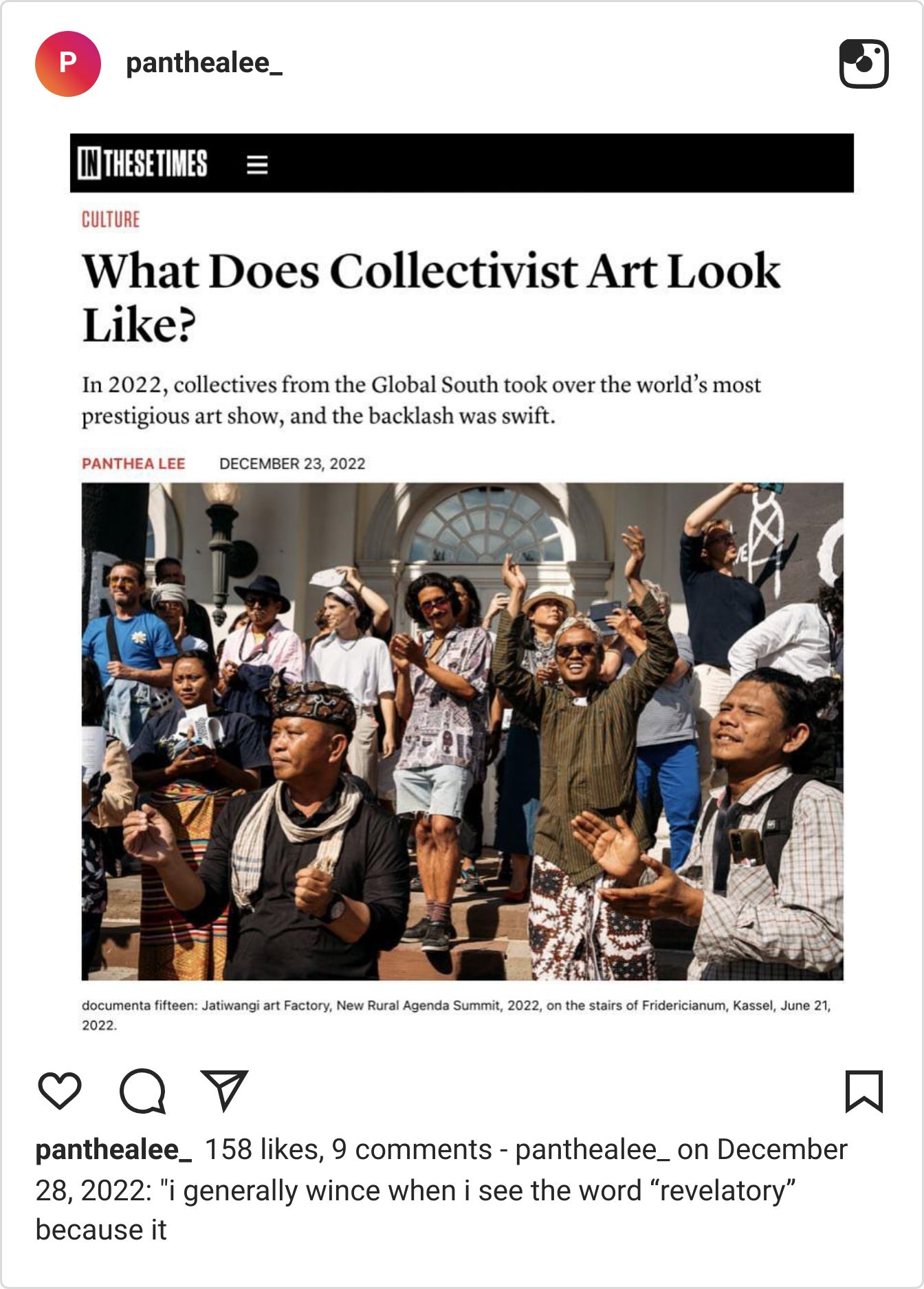
Ruangrupa springs from the moment in 1997 when the people overthrew Indonesia’s US-backed dictator, Suharto. As the people rose up, a loose collective of artists sprung up, creating wood-block posters, street theatre, and shadow puppetry. Their manifesto rejected American individualism, “a system that destroys art workers’ morality through working only for individual interests without thought of community interests.” At present, the collective runs Gudskul, a school that helps people create artist collectives, teaching the “history of collectivism, the politics of spatial practices and collective finances”, but also offering space for a radio station, a coffee shop, a tattoo parlor, a library, and more.
When Ruangrupa was named the curator of documenta 15, they sought to practice their collectivist principles. As Lee writes,
For documenta 15, ruangrupa negotiated higher artist fees, invited art collectives it admired to co-create the exhibit, and asked those groups to invite others. The collaborators ballooned to a record 1,500 artists. Participants sold work through a cooperative gallery. Ruangrupa battled German bureaucracy to send money to Global South collectives and negotiated to donate a portion of ticket sales to ecological projects, including a sustainability festival in Sumatra, Indonesia, and land reforestation near the exhibition’s home of Kassel, Germany.
Similarly, in solidarity with unhoused people in Kassel, they chose to make all their major press announcements in Asphalt, a street newspaper dedicated to, and a vehicle for making money for homeless people (for those of you from Seattle, it sounds like the same model as Real Change).
In the New York Times, Samanth Subramanian writes , “Instead of collaborating to make art, ruangrupa propagates the art of collaboration. It’s a collective that teaches collectivity. For its projects, ruangrupa solicits accomplices: artists, of course, but also those otherwise stranded on the art world’s margins, like slum residents or factory workers. Out of these social relations and communal feeling.”
Ruangrupa modeled their documenta 15 exhibition on lumbung, a rice store shared by Indonesian villages, a “commons.” To create this lumbug, Ruangrupa invited 14 collectives from around the world (mostly from the Global South) and asked them to select artists, creating what Subramanian calls “a virtuous pyramid scheme.” Ruangrupa spread Documenta’s funds widely, encouraging autonomy over curatorial control. The event featured an aesthetically beautiful public daycare, free tickets, a small arts festival in Sumatra, organizing workshops, and a summit of artists from Congo, Mali, and Palestine opposing the UN’s New Urban Agenda.
By centering collectivity, Ruangrupa creates art that invites audiences into the making, that builds actionable spaces (like daycares or organizing spaces) as opposed to sterile spaces for “art for art’s sake.” At documenta 15, they modeled what collectivist art might look like, both in aesthetics and structure.
Think someone would enjoy this newsletter? Forward it along!
1 Eric Bennet’s Workshops of Empire is a great read on the history of the CIA’s funding of the Iowa Writers Workshop.
