
Reminder that once a month, this newsletter publishes I Will Always Love You, an advice column for creative collaborations (inspired by Dolly Parton herself). I’m looking for questions about your love affair with your lighting designer, your jealousy of your conservatory classmate, your long-distance literary penpal angst, and much more. You can read more about the inspirations for this column here, and you can submit a question here.
Here is your monthly round-up of art, reading, and thinking. I really enjoy collecting these all month and have loved hearing that you appreciate these round-ups. I will say that these are not going to be strictly chronological; I’ve been hoarding some of these for a while. Enjoy!
Elia Ayoub’s essay “An elder is someone who is older than olive trees”
Elia was one of my classmates in Raechel Anne Jolie’s EXCAVATIONS class this fall. I was moved by this essay of his, wherein he collages together motifs (olive trees, trains, the sea, maps) to depict the violence of borders and the pain of exile. A few favorite passages:
I imagine trees communicating with those on ‘the other side’ through their roots before 1948. Something about mycellium. I barely understand it, but it feels like a smart way to go about things. Some trees probably kept these roots going for longer than our grandparents were able to. Maybe some of them saw my grandfather crossing the land above them before people equipped with History with a capital H decided that to the south of this point on the land shall be a state called Israel. That’s why the Israelis keep on punishing olive trees, and why my grandfather could never go back.
If I get lost, I just have to locate the sea, make my way to Beirut, and then from Beirut make my way up to my village. If I am north, the sea has to be on my right to return to Beirut. If I am south, the sea has to be on my left. That’s why even today, in exile/diaspora, I have to know where the sea is at all times lest I fall into non-existence.
He concludes the essay with a fantasy of the train in Miyazaki’s Spirited Away, imagining a train that could let him travel and return, with the sea on every side.
In Spirited Away they present their tickets, and then just sit down. I can’t even tell if they’re going north or south or east or west or if these things matter over there. The magical train is entirely surrounded by the sea. It's neither left nor right. The passengers don't worry about such trivial things. Save me a seat. Please.
Why You Mad from Jake Flores and Luisa Diez
Two of my favorite parasocial relationships are back after a hiatus. Thank god. From standup comedian Jake Flores and comedy booker Luisa Diez, Why You Mad is a “leftist Latino philosophy podcast about art, standup comedy, and other things that make us mad.” I’ve listened to them for years, and honestly, their analysis of art and clarity of politics helped radicalize me.
Since returning from their hiatus, they published an episode featuring a “comradely critique” of Comedian Chris Gethard’s Vulture article “on the end of the middle-class comedy job,” discussing how artists often treat ourselves as superior to the broader working class, causing us to abandon both solidarity and artistic integrity. Jake and Luisa are funny and chatty, they love art ferociously (and are thus furious when it’s used to punch down), and have consistently stretched and expanded my politics.
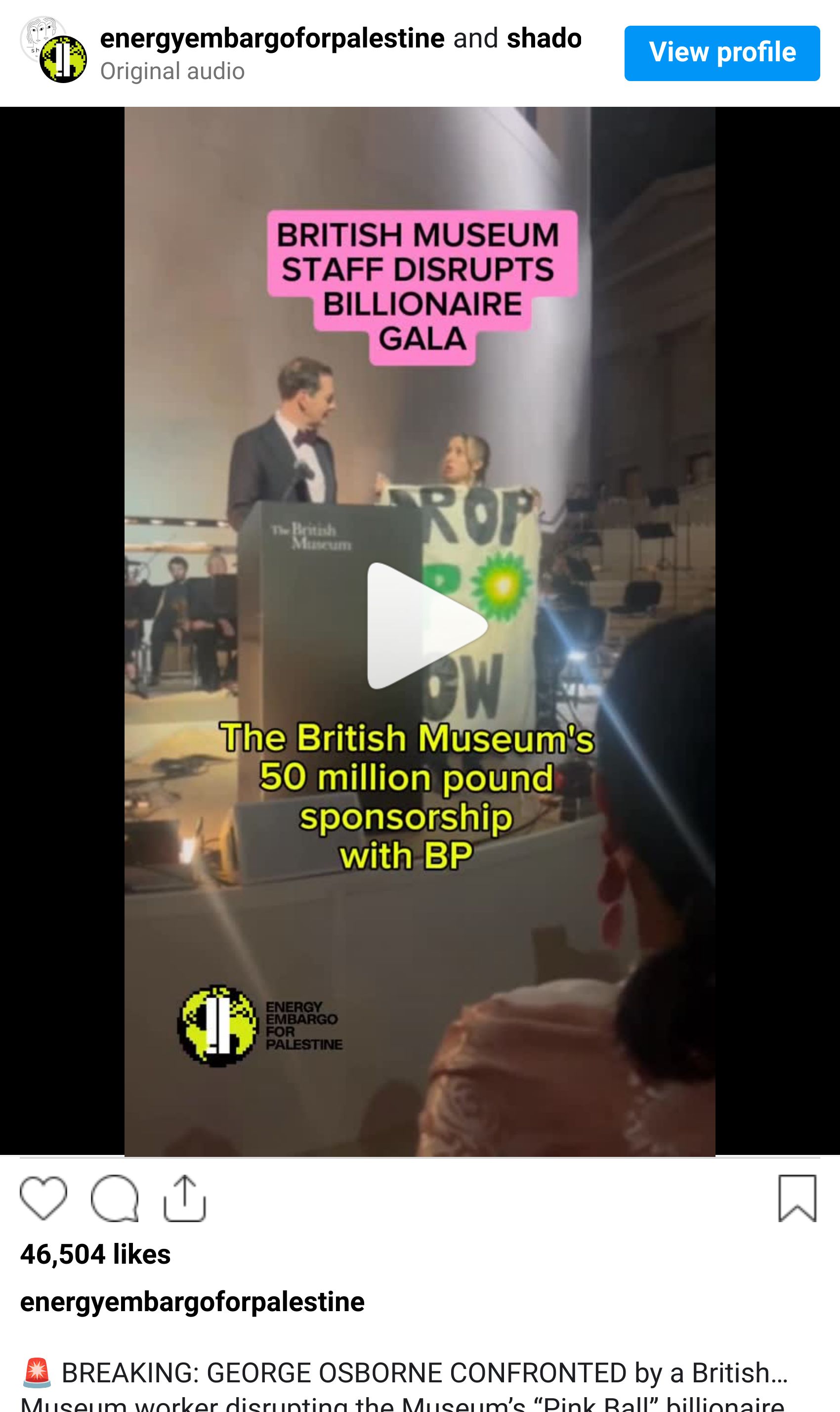
In October, the British Museum threw its version of The Met Gala. The theme “Ancient India,” was, on its own, insulting, given the museum’s long history of colonial theft. But organizers also chose to protest the event because of British Petroleum’s 50 million pound sponsorship of the museum. BP is not only one of the key drivers of the climate catastrophe, they are also actively aiding and profiting from the genocide in Gaza. A group of organizers protested outside the museum, but one woman, a waitress for the event’s catering company, smuggled a banner in under her uniform and interrupted the gala’s program. Dazed magazine interviewed her, and this quote stood out:
If you disrupt any form of normality, you’re seen as the hysterical one, but it’s actually insane to not be affected. We should all have some level of insanity, after watching a genocide for two years.
Boots Riley bought the rights to Anne Washburn’s Mr. Burns: A Post-Electric Play

Source: Playwright’s Horizons. Matthew Maher, Susannah Flood, Quincy Tyler Bernstine, Sam Breslin Wright, Colleen Werthmann, Nedra McClyde, and Gibson Frazier; photo by Joan Marcus
This news was emotional whiplash. Anne Washburn’s play Mr. Burns: A Post-Electric Play was one of my favorite plays of the 2010s. Set in a post-apocalyptic world after electricity, it begins with people sitting around a campfire, telling each other the story of a specific Simpsons episode; electric entertainment is stripped to oral tradition. Throughout the play, over decades in the post-electric world, this Simpsons episode becomes the basis for an artistic economy and ultimately a theology. It’s a play obsessed with storytelling, whose theatrical form mirrors its content. Thus, when a friend told me it was being adapted into a film, I felt rage! This is a play about theatre! A film could only ruin it!
But, a sentence later, my friend told me the filmmaker would be Boots Riley, the auteur behind 2018’s Sorry to Bother You and the frontman of the radical hip hop group The Coup. My rage became delight! Excitement! Intrigue! Both artists are dogged experimentalists with a taste for the absurd and the surreal (but who dodge avant-garde pretension). While Washburn’s play contains an undercurrent of politics, I think Riley’s more explicit Marxism will add fascinating new layers to the work. I’m thrilled! I can’t wait!
Go Fish written by Guinevere Turner and Rose Troche
If, on a Tuesday night, you are looking for a charming, ninety-minute lesbian rom-com, this is the film for you. This 1994 ultra-low budget film (made with just $17K) was a Sundance sleeper hit and one of the first movies to “prove” there is a “market” for lesbian stories.
I’m particularly charmed by its filmmaking style. While maintaining a pretty straightforward, linear narrative, the film has a playful, unserious avant-garde aesthetic. It’s shot in black-and-white and features collage-like montages as transitions between scenes (book pages flipping, cream clouding coffee, a top spinning, hands stroking someone’s back). This kind of collaged technique is not uncommon in cinema—Kristen Stewart’s recent The Chronology of Water, for example, uses it deftly to evoke the fragmentation of trauma—but Go Fish uses this technique for fun, to be artsy for the sake of it. This feels charmingly 90s to me. Why don’t we make films like this anymore? Why, during this “90s revival” moment, don’t we have cutely experimental, queer, super low-budget rom-coms? Get on it, friends!
I’m a longtime fan of both Samin Nosrat (the author of Salt, Fat, Acid, Heat) and Prentis Hempill (the author of What it Takes to Heal, and the former Healing Justice Director at Black Lives Matter Global Network). I’ve read both of their books and listen to their podcasts religiously. However, they’ve always existed in different corners of the internet, so I was surprised and delighted to see Samin appearing on Becoming the People, Prentis’s podcast. I’ve heard Samin talk a lot, and this is by far my favorite interview of hers.
The episode begins with Prentis complimenting Samin’s embodiment, “the first thing I noticed about you,” they say. The episode then features a deeply vulnerable discussion from Samin about a massive depressive episode and the loss of her estranged father. She says,
I was thrown into the depths of my own depression. And I met it. I went there. And I clawed my way back out. And it was just when I was sort of stabilizing again that my dad went into the hospital, and that threw the next year off-kilter. But honestly, because I had done this other work first, I was able to meet this experience with my dad. And inside of all of that, there was this book I was supposed to be writing. It felt so meaningless, like…how can I possibly be this avatar for your joy through cooking soup when all I want to eat is Barbara’s cheese puffs and frozen pizza and barely survive?
I have immense respect for people who go through a self-shattering experience and must heal themselves from scratch. People experience this through grief, divorce, illness, trauma/trauma healing, addiction, politicization, and much more. I went through this several years ago, crashing and then reconstructing myself from the floorboards. It’s deeply humbling and painful to experience, but I have such gratitude for who I’ve become in the process. Semi-ironically, I keep telling a dear friend of mine that she should have a crisis; there’s such cool integrity and self-esteem on the other side, girlie!! I think I will have lived a good life if I have 2-4 of these crises before I die. I was moved to hear Samin’s narration of hers.
The two end with a discussion of food and pleasure. After this reckoning with her father’s “pathetic” death, she frames her commitment to “Good Things” (the title of her cookbook) as a reckoning with her mortality. “What is it that I want to be able to look back on when I’m dying?” She says. “That became a very clear and helpful lens for me in making choices about my life.” Prentis and Samin make a case for turning towards shared delights, not to bypass the inevitability of pain, cruelty, and death, but to face them.
A few other favorites:
Two works from Charlotte Shane: her essay “Someone’s Gotta Write It” and her memoir An Honest Woman.
The Bridge Project at Seattle’s Velocity Dance, featuring three in-process works by emerging artists: Miguel Almario, Olivia Anderson, and Jessica Jobaris & General Magic. I really enjoyed all three pieces, but was particularly taken by Almario’s work Hard Feelings, which featured an ensemble that moved seamlessly together and created a strong sense of place with just a few objects.
MAJOR, created by Ogemdi Ude, at On the Boards. An incredibly fun and poignant dance theatre piece “exploring the physicality, history, sociopolitics, and interiority of majorette dance.”
For a bit of pure pleasure, watch Olympic Champion1 Jordan Chiles’ perfect-ten floor routine.
I went to the opening of Sweethearts: a t4t art show, which was packed, featured over fifty artists, and showed some really incredible works. Here’s a highlight:

A mosaic from the (anonymous) creator of Cal Anderson Park’s Hot Rat Summer Mosaic

1 She’s obviously a medalist in the team competitions, but as far as I’m concerned, they can take the 2024 bronze medal from her cold, dead hands.
