

It is a breezy, lovely Seattle spring week, warm enough to be writing this while eating French fries on a dive bar patio. For this week’s newsletter, I’m shaking out a drawer of bits and bobs. I love curating the monthly roundups, and there are always a few things I love that I don’t get around to including. So here they are! I encourage you to read them on a patio if at all possible!
I. Novelist Torrey Peters’ craft talk “On Strategic Opacity”. She basically argues that the most engaging fictional characters have “strategically opaque” motivations—you don’t always know why they take the actions they take; she uses Hamlet as a case study. I always found the theatre-school, Stanislavskian obsession with clearly-articulated “objectives” reductive, strange, and…sorta dehumanizing. It always made me feel stupid because I was bad at it. Peters explains this with such charm!
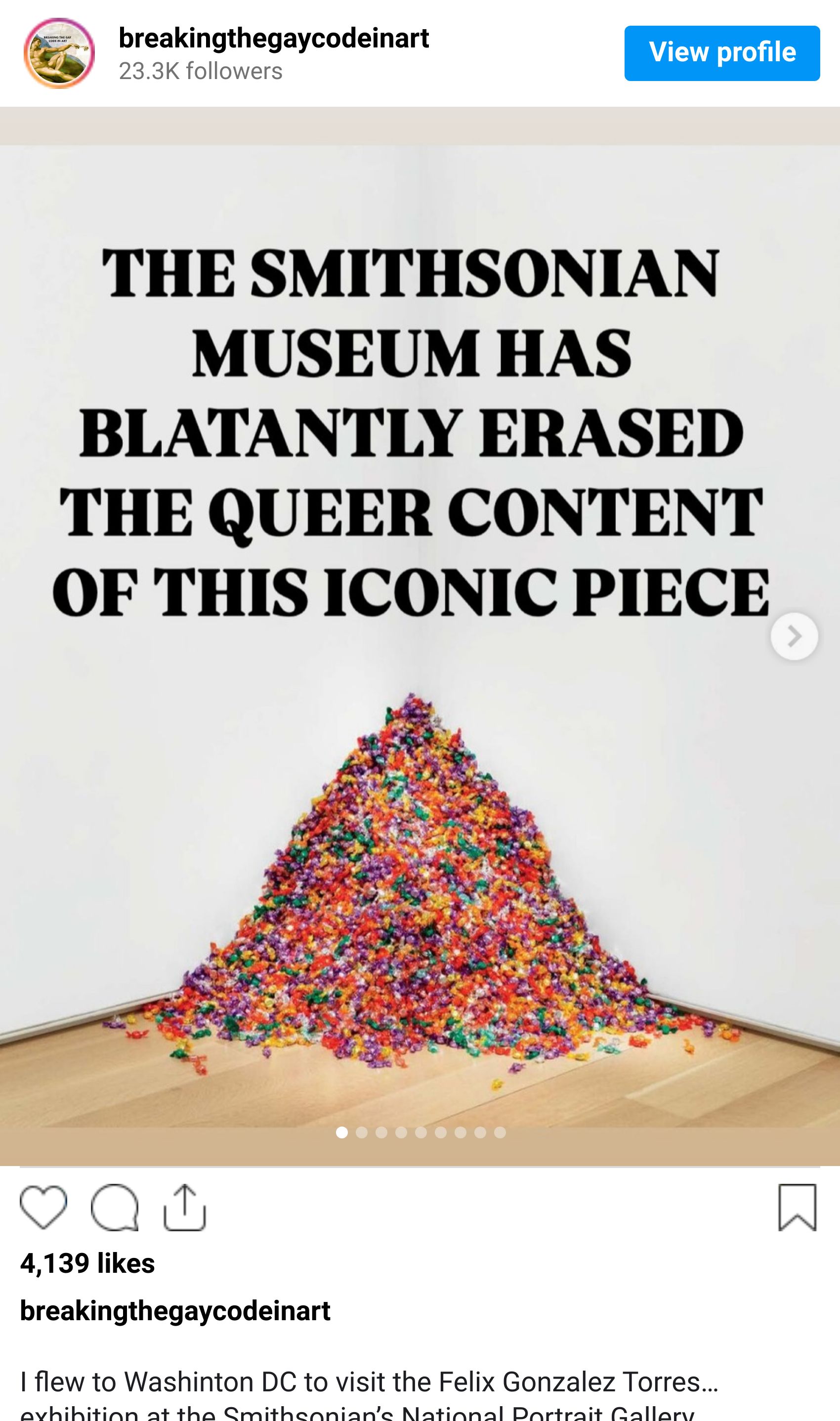
II. In 1991, Félix González-Torres created "Untitled" (Portrait of Ross in L.A.)”. This work features a pile of candy weighing 175 pounds, the same weight as his lover before he began dying of AIDS. Scholar Ignacio Darnaude describes seeing the work for the first time: “When I understood the profound meaning of this installation as an AIDS memorial, and realized how, as the museum keeps replenishing the pile, Felix is giving his partner eternal life, I burst into tears, experiencing the transformative power of art.”
Unfortunately, last year, the Smithsonian displayed it, but the exhibit included no mention of the AIDS crisis. Instead, it turned to art-speak, describing the “multiple dynamic meanings of his work,” and refers to 175 pounds as the “average body weight of an adult male,” with no mention of Ross. This curation frankly turns my stomach, changing a memorial to a lover into an academic, heartless aesthetic exercise. As Darnaude writes, “It's devastating to see how the labels at the current Smithsonian retrospective focus on banal questions such as, ‘Can I eat a portrait? Is it OK to take something from a museum?’”
III. A very cute interview about curating an “at-home artist residency” (a schedule and snacks are crucial). I wanna do this!
IV. In NplusOne, Elias Rodriques’ essay “Lifetime Achievement” about Andil Gosine’s exhibition Nature’s Wild, which the Art Museum of the Americas cancelled, obeying Trump’s executive orders in advance. He investigates the cancellation to better understand “what the repression of [Gosine’s] art had actually accomplished.” “Trump was — and is — intent on creating a new future,” he writes, “and to gain a better sense of that vision, I needed to understand what future he was working to prevent.” A favorite passage:
Perhaps because I have been poor and declined invitations to various activities I could not afford, I have never thought that money is simply money. I think of the Marx passage that I perennially misquote: “Capital is not a thing, but a social relation between persons, established by the instrumentality of things.” I may not know firsthand what the wealthier side of the relationship stands to gain from the wielding of capital to cancel exhibitions, but I have some sense of what I and others stand to lose from an absence of public art and of wages. I may not be convinced of art’s importance, but I have some sense of the importance of censoring art: doing so offers a dismal forecast for the future. If a person cannot display ceramic eggs in a museum, I think as I stand on the right of an escalator, then a great deal is at risk.
V. Ard: To Belong to Land, A gorgeous exhibition of Palestinian photographers in Milan. I’m particularly enamored of Jenna Masoud’s image of swimmers in the Dead Sea—so joyful, but with an Israeli-imposed border down the middle of it. “It’s perverted and unnatural to impose man-made borders on a lake,” the curator Dalia Al-Dujaili said to journalist Olivia Hingley. “The universality of the moment connects Palestinians to wider humanity, highlighting that this is not an isolated struggle.”

VI. I loved Daniel Yadin’s essay in The Drift about the romantasy craze (a craze I have not resisted). In it, while gorging on these page turners, he explores the desire to escape through art when surrounded by uncertainty and horror. But he argues that escape robs us of agency, of the pleasure of our one precious lives. A favorite passage (which I thought about a lot while writing my T.S. Eliot essay Do I Dare?): “Action — that way of touching existence, being inside of experience, engaging with the mess of life — is what makes the world, to use Keats’s phrase, “the vale of soul-making.” It’s also what makes it, for that matter, the vale of adulthood.“
VII. Lewis Raven Wallace on the importance of movement journalism:
I think of archives as possibly the simplest and most attainable purpose for movement journalism — the “slam dunk” purpose. What we create doesn’t have to reach a large audience. It doesn’t have to contain every voice or address every angle. It just has to document the truth right now, to get a story of struggle or survival into an archive that lasts long enough for another generation to see.
